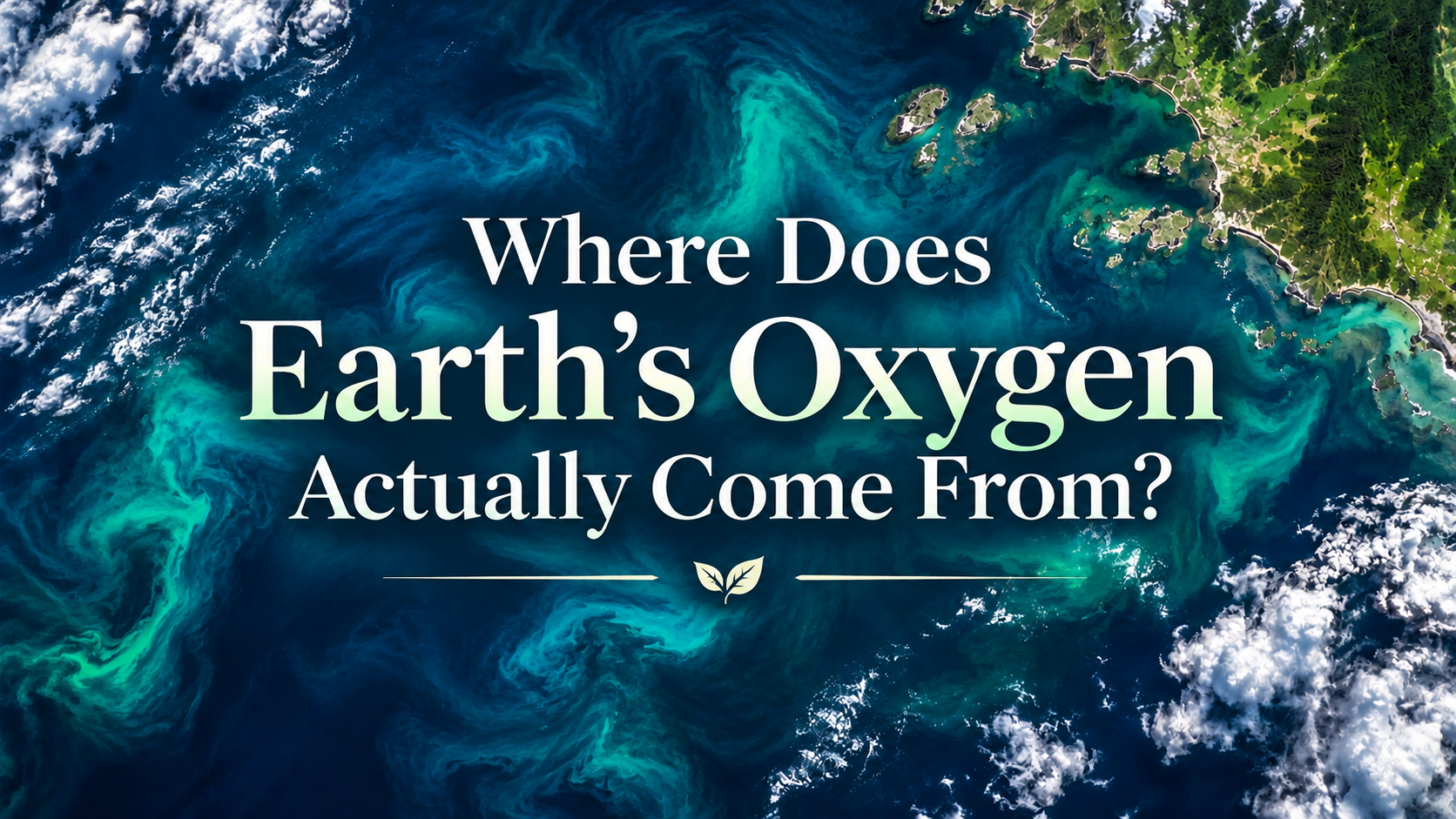
Title image generated with AI
When we think about the oxygen we breathe, we often picture vast green forests, towering trees, and lush tropical rainforests. After all, plants produce oxygen through photosynthesis, so it seems natural to assume that forests provide most of the air we need to survive. But the truth is far more surprising.
Some of Earth’s most important oxygen producers are so small that we cannot even see them without a microscope. They live in oceans across the planet, quietly transforming sunlight into energy and releasing oxygen as a byproduct.
So where does Earth’s oxygen actually come from? And how much of it is produced by forests compared to the ocean? To answer these questions, we need to look at the remarkable biological processes that have shaped our atmosphere for billions of years.
How Is Oxygen Produced on Earth?
Most of the oxygen produced by living organisms on Earth comes from a process called photosynthesis. During photosynthesis, plants, algae, and certain bacteria capture energy from sunlight and use it to convert carbon dioxide and water into organic compounds. Oxygen is released as a byproduct.
The simplified chemical equation looks like this: 6 CO₂ + 6 H₂O + light energy → C₆H₁₂O₆ + 6 O₂
In other words, photosynthetic organisms use sunlight to build the molecules they need for growth while releasing oxygen into their surroundings. On land, this process happens primarily in the leaves and other green tissues of plants. In aquatic environments, it occurs in organisms ranging from large seaweeds to microscopic plankton.
However, producing oxygen is not the same as permanently adding oxygen to the atmosphere. Plants, animals, fungi, and many microorganisms also consume oxygen through cellular respiration. When dead organic material decomposes, much of the oxygen originally released during photosynthesis is effectively consumed again. This distinction is essential to understanding Earth’s oxygen cycle.
The Ocean – Earth’s Hidden Oxygen Factory

Image generated with AI
Although forests receive much of the attention, the ocean is responsible for an astonishing share of global oxygen production. According to the National Oceanic and Atmospheric Administration (NOAA), scientists estimate that roughly half of Earth’s oxygen production comes from the ocean.
And the organisms responsible are not primarily large marine plants. Much of this oxygen is produced by microscopic photosynthetic organisms floating in sunlit ocean waters.
Together, these organisms form the photosynthetic component of phytoplankton, a diverse community that includes microscopic algae and cyanobacteria.
Like terrestrial plants, they absorb sunlight and carbon dioxide, releasing oxygen during photosynthesis. Despite their tiny size, their combined activity is enormous. Phytoplankton inhabit vast areas of the world’s oceans. Wherever sunlight penetrates sufficiently into the water and suitable nutrients are available, these organisms can grow and reproduce.
Their populations can sometimes become so abundant that they form enormous blooms visible from space. But there is an important detail: much of the oxygen produced in the ocean is also consumed by marine organisms and decomposition.
Therefore, the fact that oceans generate approximately half of global oxygen production does not mean they continually supply half of the oxygen currently stored in our atmosphere. That atmospheric oxygen represents the result of processes operating over geological timescales.
Meet the Microscopic Organisms That Keep Us Breathing
The ocean’s oxygen producers are remarkably diverse. Some are single-celled algae with intricate mineral structures, while others are bacteria that evolved the ability to perform oxygen-producing photosynthesis billions of years ago.
The NASA Earth Observatory’s introduction to phytoplankton offers a fascinating look at these organisms and their ecological importance. Among the most remarkable groups are the following.
Prochlorococcus – A Tiny but Powerful Producer
Prochlorococcus is a genus of extraordinarily small marine cyanobacteria. Individual cells are typically less than a micrometer across, making them considerably smaller than most plant cells. Yet these microorganisms are among the most abundant photosynthetic organisms in the ocean.
They thrive particularly well in nutrient-poor tropical and subtropical waters, where their ability to use available light and resources efficiently gives them an advantage. Collectively, they contribute substantially to marine photosynthesis and global carbon cycling. Their importance is a striking reminder that an organism does not need to be large to influence an entire planet.
Diatoms – Microscopic Architects of the Ocean
Image generated with AI
Diatoms are single-celled algae famous for their beautiful silica cell walls, known as frustules. These structures often display intricate geometric patterns that resemble tiny works of glass architecture. Diatoms occur in marine and freshwater environments and are particularly important in nutrient-rich waters.

Through photosynthesis, they produce oxygen and organic matter that supports aquatic food webs. When diatoms die, some of their organic material sinks into deeper waters. A small fraction may eventually become buried in sediments, contributing to the long-term carbon cycle.
Coccolithophores – Algae Covered in Tiny Plates
Coccolithophores are another fascinating group of marine phytoplankton. These microscopic algae are covered with tiny plates made of calcium carbonate, called coccoliths. Under certain conditions, their blooms can become extensive enough to alter the color of the ocean surface, creating pale, turquoise patterns visible from satellites.
Alongside oxygen production, coccolithophores play a role in the marine carbon cycle through both photosynthesis and the formation of their calcium carbonate plates. Together, these different organisms illustrate the extraordinary biological diversity behind the oxygen-producing activity of the oceans.
What About Trees and Rainforests?
Image generated with AI
If the ocean produces roughly half of Earth’s oxygen, what does that mean for forests? Trees, grasses, shrubs, and other terrestrial plants account for much of the remaining biological oxygen production.
Tropical rainforests are particularly productive ecosystems because their warm temperatures, abundant rainfall, and dense vegetation support extensive photosynthetic activity. However, there is a widespread misconception that the Amazon rainforest produces 20% of the oxygen we breathe. This figure is misleading.
Rainforests generate substantial quantities of oxygen through photosynthesis, but their organisms also consume oxygen through respiration and decomposition. Over time, much of the oxygen produced within a mature forest ecosystem is balanced by these processes. Consequently, a rainforest’s net contribution to the long-term accumulation of atmospheric oxygen is far smaller than its gross oxygen production might suggest.
Does that mean rainforests are less important than we thought? Absolutely not. Their ecological significance extends far beyond oxygen production. Rainforests store enormous amounts of carbon, influence regional and global climate patterns, regulate water cycles, and provide habitats for an extraordinary variety of organisms. They are among the most biologically diverse ecosystems on Earth.
To discover how these complex relationships work, explore my article on The Rainforest Ecosystem. Protecting forests remains essential, even if the familiar idea of rainforests as the planet’s primary oxygen suppliers is scientifically inaccurate.
Why Doesn’t All Produced Oxygen Reach the Atmosphere?
One of the most fascinating aspects of Earth’s oxygen cycle is that oxygen production alone does not explain why our atmosphere contains so much of it. To understand that, we need to distinguish between gross oxygen production and net oxygen accumulation.
Photosynthesis releases oxygen, but respiration and decomposition consume it. When organisms use organic molecules for energy, oxygen is often involved in converting those molecules back into carbon dioxide and water. This effectively reverses much of the oxygen-producing effect of photosynthesis.
So how did oxygen accumulate in the atmosphere in the first place? The answer lies partly in the long-term burial of organic carbon. When photosynthetic organisms produce organic matter, a small proportion can escape complete decomposition and become buried in sediments.
Because this carbon is not immediately returned to the environment as carbon dioxide, the corresponding oxygen can remain available rather than being consumed through the usual biological cycle. Over immense geological periods, this process helped oxygen accumulate in Earth’s atmosphere. Other geological processes, including reactions involving sulfur and reduced minerals, also influence the long-term oxygen balance.
The Great Oxidation Event
For much of Earth’s early history, the atmosphere contained very little free oxygen. Oxygen-producing photosynthesis evolved in microorganisms long before oxygen became abundant in the air. Approximately 2.4 billion years ago, during a period known as the Great Oxidation Event, atmospheric oxygen began increasing significantly.
This transformation was one of the most important turning points in Earth’s history. It altered the chemistry of the oceans and atmosphere, affected countless existing microorganisms, and eventually helped create conditions in which more complex oxygen-dependent life could evolve.
The oxygen we breathe today is therefore not simply the product of this morning’s photosynthesis. It is part of an atmospheric reservoir shaped by billions of years of biological activity and geological change.
Why Protecting Our Oceans and Forests Matters
Understanding where oxygen comes from changes how we think about the natural world. Forests are not giant oxygen tanks that continuously replenish the atmosphere without consuming oxygen themselves. Likewise, marine phytoplankton are not simply microscopic factories supplying fresh air directly to our lungs.
Both belong to interconnected ecosystems in which oxygen, carbon, nutrients, and energy constantly circulate. And both are essential for reasons that go well beyond the oxygen they produce. Healthy oceans support marine food webs, absorb carbon dioxide, redistribute heat, and influence Earth’s climate.
Healthy forests protect biodiversity, store carbon, regulate water availability, and provide countless ecological services. Climate change, habitat destruction, pollution, and disruptions to nutrient cycles threaten these systems in different ways. Protecting them is therefore not just about maintaining oxygen production. It is about preserving the ecological processes that make Earth habitable.
A Planet Shaped by Invisible Life
Perhaps the most extraordinary part of Earth’s oxygen story is the role played by organisms we rarely notice. A microscopic cyanobacterium drifting through tropical waters may seem insignificant beside a towering rainforest tree.
Yet both participate in the same ancient process that transformed our planet. The oxygen in our atmosphere is the legacy of billions of years of photosynthesis, carbon burial, biological evolution, and geological change.
And while forests remain some of Earth’s most magnificent ecosystems, much of the planet’s ongoing oxygen production happens beneath the ocean’s surface. Sometimes, the smallest living things have the greatest planetary impact.