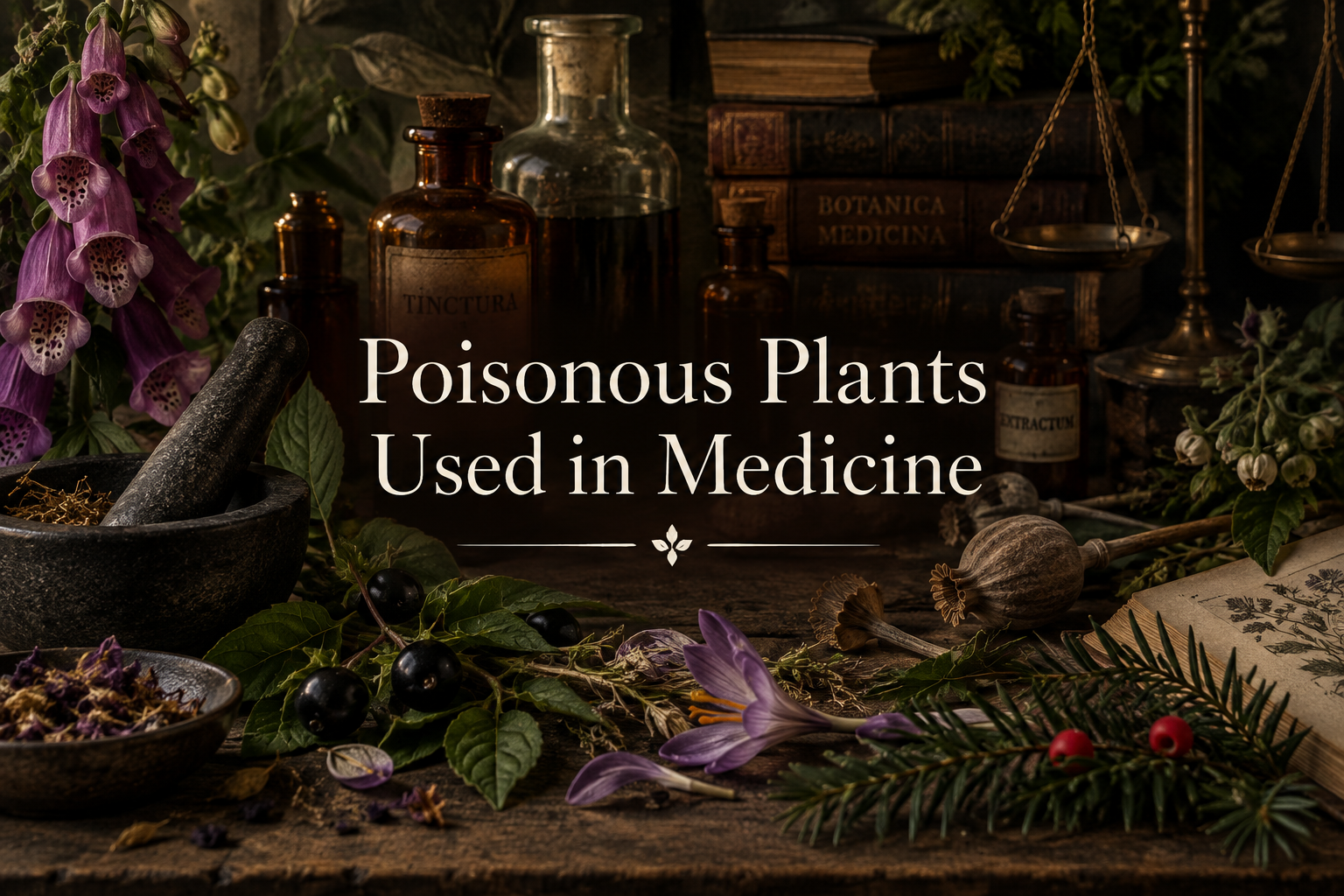
Title image generated with AI
Affiliate disclosure: This post contains affiliate links. If you make a purchase through one of these links, I may earn a commission at no additional cost to you.
Some of the most dangerous plants in the world have also given us important medicines. At first, that sounds like a contradiction. We tend to divide plants into neat categories: medicinal plants are beneficial, poisonous plants are dangerous. But nature rarely follows categories that simple. In many cases, the very compounds that make a plant toxic are also what makes it medically interesting.
The difference between a poison and a medicine can come down to dose, concentration, preparation, and how a compound interacts with the human body. Modern medicine has learned to isolate, standardize, and sometimes modify powerful plant compounds that would be dangerous or even deadly if the plant itself were consumed.
For anyone interested in the darker side of plant chemistry, Elizabeth A. Dauncey and Sonny Larsson’s Plants That Kill: A Natural History of the World’s Most Poisonous Plants (paid link) explores the biology, chemistry, and history of toxic plants in much greater detail.
When Does a Poison Become a Medicine?

Image generated with AI
Plants do not produce chemical compounds for human benefit. Many of their most potent substances evolved as defenses against herbivores, insects, pathogens, or other threats. But those chemicals can also interfere with processes inside the human body. Some affect the nervous system. Others change the rhythm of the heart, interfere with cell division, reduce inflammation, or alter the way pain signals are processed. Those effects can be dangerous but under carefully controlled circumstances, they can also be useful. That distinction is crucial.
A pharmaceutical drug derived from a plant is not necessarily equivalent to using the plant itself. Modern medicines can contain precisely measured quantities of an isolated or modified compound, while the concentration of chemicals inside a living plant can vary considerably. This relationship between poisonous plants and modern medicine is far from unusual. Kew Gardens highlights several plants that have contributed important compounds to medicine, ranging from the opium poppy to the Pacific yew.
Poisonous Plants That Became Important Medicines
Some of the best-known poisonous plants used in medicine provide remarkable examples of this thin boundary between toxicity and treatment.
Image generated with AI
Foxglove
With its tall spikes of purple, pink, or white bell-shaped flowers, foxglove (Digitalis purpurea) hardly looks threatening. Yet all parts of the plant are poisonous. Foxgloves contain cardiac glycosides, compounds capable of profoundly affecting the heart. Ingestion can cause nausea, vomiting, visual disturbances, and dangerous changes in heart rhythm. In severe cases, poisoning can be fatal. Yet foxglove also occupies an important place in medical history.

In the 18th century, English physician and botanist William Withering systematically studied its use in treating “dropsy,” an old term for the accumulation of fluid in the tissues. He observed that preparations made from foxglove could slow and strengthen the heartbeat, although he also recognized that excessive doses could be deadly. His work eventually contributed to the isolation of cardiac glycosides such as digitoxin and digoxin. These compounds became important in the treatment of certain heart conditions.
Kew Science’s profile of Digitalis purpurea explores both the plant’s medicinal history and its considerable toxicity in more detail. Foxglove therefore illustrates the central paradox perfectly: the same biological power that makes a plant dangerous can make its chemistry valuable to medicine.
Deadly Nightshade
Few plants advertise their reputation as clearly as deadly nightshade. Atropa belladonna has been associated with poisoning for centuries. Its glossy black berries may look tempting, but the plant contains powerful tropane alkaloids, including atropine and scopolamine. These compounds interfere with the action of acetylcholine, an important neurotransmitter involved in many functions of the nervous system. Poisoning can cause dilated pupils, dry mouth, confusion, hallucinations, rapid heartbeat, seizures, and potentially death.
Yet atropine also has legitimate medical uses. It can be used in certain medical emergencies to increase a dangerously slow heart rate and as an antidote to particular types of poisoning. Its ability to dilate the pupil has also made atropine useful in ophthalmology. Once again, the plant itself and the pharmaceutical compound should not be confused. Eating belladonna is not a primitive version of taking atropine. One involves an unpredictable mixture of toxic compounds; the other involves a controlled dose used for a specific medical purpose.
Autumn Crocus
Autumn crocus (Colchicum autumnale) produces delicate purple flowers that emerge from the ground in late summer or autumn. Its appearance gives little indication of how dangerous it can be. The plant contains colchicine, a highly potent compound that interferes with microtubules – structures that play an essential role in cell division and other cellular processes.
Colchicine is also an established medicine. In carefully controlled doses, it is used particularly in the treatment of gout and some other inflammatory conditions. Kew includes autumn crocus among the plants whose chemistry has contributed to modern medicine. But colchicine has a narrow margin for error. Excessive exposure can cause severe poisoning, including gastrointestinal symptoms, organ failure, and potentially death. The autumn crocus is therefore another reminder that medicinal value does not make a poisonous plant safe.
Opium Poppy
Few plants demonstrate the complicated relationship between medicine and poison as dramatically as the opium poppy (Papaver somniferum). Its latex contains numerous alkaloids, including morphine and codeine. These compounds have had an enormous impact on medicine, particularly in the treatment of pain. Morphine remains one of the most important opioid painkillers available. But the same class of compounds can suppress breathing and cause physical dependence, addiction, and fatal overdose.
That duality has followed the opium poppy throughout its long relationship with humans. It has been a source of extraordinary pain relief as well as profound harm. The history of the plant goes much further than its medical uses, from ancient cultivation to the myths that still surround it today. I explore that story separately in The Truth About Opium Poppies: History, Botany & Myths.
Yew
Yew trees may seem like unlikely candidates for a medical breakthrough. Species of Taxus contain highly toxic compounds, and many parts of the trees can cause severe or fatal poisoning if eaten. Yet this same plant group became the source of one of the most important classes of anticancer drugs. Paclitaxel was originally discovered in the bark of the Pacific yew (Taxus brevifolia). Rather than poisoning cancer cells in a simple sense, paclitaxel interferes with the microtubules cells need to divide successfully. This makes it useful against several types of cancer.
Its discovery also created an unexpected conservation problem. Obtaining the compound from Pacific yew bark required removing the bark, killing the tree in the process. As demand for paclitaxel increased, concerns arose about relying on wild trees for production. Researchers later developed methods that allowed the drug to be produced using more sustainable sources and processes. The story of the yew shows another side of medicinal botany: discovering a useful compound is only the beginning. Scientists must also find ways to produce it safely, consistently, and sustainably.
Why Traditional Plant Medicine Can Be Dangerous

Image generated with AI
The medical history of these plants can make traditional remedies sound surprisingly sophisticated. In some cases, traditional observations genuinely helped point researchers toward biologically active compounds. But historical use is not proof that a treatment is safe or effective. Before modern pharmacology, people had no reliable way to measure many of the compounds they were consuming. The concentration of a toxin can differ between species, individual plants, growing conditions, seasons, and even different parts of the same plant.
Identification introduces another risk. A poisonous species mistaken for an edible or medicinal plant can have devastating consequences. Foxglove, for example, has been involved in poisonings after its leaves were mistaken for other plants. And “natural” offers no protection from toxicity. Some of the most powerful poisons known to humans are natural substances. Plants evolved their chemistry long before humans began turning that chemistry into medicines.
This is why poisonous medicinal plants should never be treated as DIY pharmaceuticals. The fact that a modern drug originated from a plant does not mean consuming that plant produces the same treatment.
The Thin Line Between Healing and Harm
Poisonous plants challenge the idea that nature can easily be divided into things that heal and things that harm. Foxglove can disrupt the rhythm of the heart, yet its chemistry helped transform cardiac medicine. Belladonna contains dangerous neurotoxins, yet atropine became an important pharmaceutical compound. Autumn crocus can cause severe poisoning, while colchicine is used to treat disease. Opium poppies gave medicine extraordinarily powerful painkillers. And toxic yew trees helped provide drugs capable of fighting cancer.
These plants are not medically interesting despite their toxicity. In many cases, they are medically interesting because their chemistry has such powerful effects on living cells and biological systems. Modern medicine does not remove that danger. It learns how to control it.
And perhaps that is one of the most fascinating things about poisonous plants: sometimes the boundary between a remedy and a poison is not found in the plant at all, but in how humans learn to understand and use its chemistry.