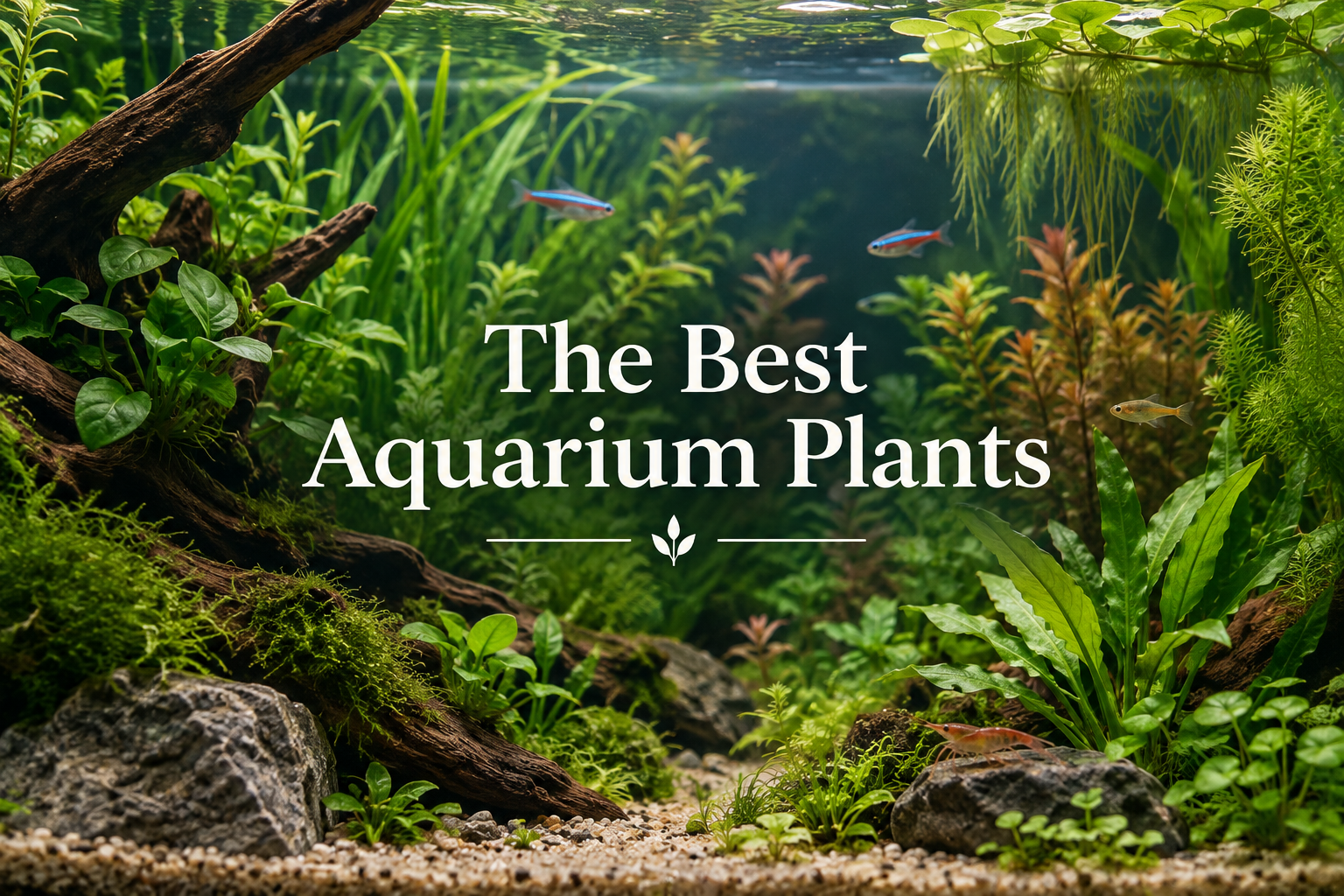
A planted aquarium is more than a beautiful underwater landscape. Living plants become part of the aquarium’s ecosystem, interacting with the water, microorganisms and animals around them.
In natural freshwater environments, aquatic plants provide habitat, contribute oxygen through photosynthesis and create surfaces where algae, bacteria and other microorganisms can live. The University of Florida IFAS Center for Aquatic and Invasive Plants highlights these functions as some of the reasons aquatic plants are essential components of healthy freshwater ecosystems.
While an aquarium is much smaller and more controlled than a natural lake or river, choosing the best aquarium plants can help create a diverse and dynamic underwater environment rather than simply adding decoration.
Why Aquarium Plants Matter

One of the most useful characteristics of aquatic plants is their ability to take up nutrients directly from their environment. Nitrogen, phosphorus and other nutrients that plants need for growth are also part of the nutrient cycle within an aquarium. Research into freshwater macrophytes and their effects on nutrient cycling and water quality shows just how closely aquatic plant growth is connected to the chemistry and biological processes of freshwater environments.
Plants also add physical structure. Dense leaves can create shelter for small fish and shrimp, mosses provide intricate surfaces for microorganisms and biofilms, and floating plants introduce an entirely different habitat at the water’s surface. That does not mean that more plants automatically create a healthier aquarium. A successful planted tank depends on choosing species that suit its conditions and combining plants with different growth habits.
What Makes a Good Aquarium Plant?
There is no single “best” aquarium plant. A species that thrives in one tank may struggle in another because aquarium plants differ considerably in their requirements. Light is one of the most important factors. Some species tolerate relatively low light, while others need much brighter conditions to grow well. The available space matters too: a small Anubias has a very different effect on an aquarium than tall Vallisneria spreading across the background.
Growth rate is another useful consideration. Fast-growing plants can take up nutrients quickly but usually require more frequent pruning. Slower-growing plants require less maintenance but perform a different role within the aquarium. For a diverse planted tank, it often makes more sense to combine several growth forms – rooted plants, epiphytes, mosses, fast-growing stems and floating plants – rather than filling the aquarium with many species that occupy exactly the same space.
The Best Aquarium Plants
1. Anubias (Anubias barteri)
Anubias is an excellent choice for adding sturdy greenery without demanding particularly intensive care. Its thick, broad leaves create structure and provide surfaces for biofilm to develop. Unlike conventional rooted plants, Anubias grows from a rhizome that should remain above the substrate. It can instead be attached to rocks or driftwood, making it particularly useful for incorporating plants directly into the aquarium’s hardscape.

2. Java Fern (Microsorum pteropus)
Java fern is another hardy epiphyte that can grow attached to rocks and wood. It tolerates relatively low light and does not need to be planted into nutrient-rich substrate. Its long leaves make it useful for creating height and shelter around hardscape without taking up large areas of open substrate.
3. Amazon Sword (Echinodorus grisebachii)
For a larger statement plant, Amazon sword can create a dense area of broad leaves extending from the substrate into the water column. It develops an extensive root system and benefits from nutrients available around its roots. Because mature plants can become quite large, Amazon sword is better suited to tanks that have enough space for it to develop without overwhelming neighboring plants.
4. Vallisneria (Vallisneria spp.)
The long, ribbon-like leaves of Vallisneria make it particularly useful as a background plant. Under suitable conditions, it spreads through runners and can gradually form dense underwater stands. This creates plenty of vertical structure while still leaving the foreground open for smaller plants and swimming space.
5. Water Wisteria (Hygrophila difformis)
Water wisteria is a fast-growing stem plant with finely divided leaves. Its relatively rapid growth makes it especially interesting when the aim is to include plants that actively use available nutrients. Regular pruning prevents it from becoming too dominant and encourages a denser, bushier form.
6. Hornwort (Ceratophyllum demersum)
Hornwort is unusual because it does not need to root in the substrate at all. It can grow freely in the water and produces masses of fine, branching foliage. Those dense stems create complex hiding spaces for small aquarium inhabitants while the plant’s fast growth allows it to take up nutrients from the water column.
7. Java Moss (Taxiphyllum barbieri)
Java moss may be small, but its tangled growth creates an enormous amount of fine structure. This makes it especially valuable in aquariums containing shrimp or very small fish. It can be attached to rocks and wood, where it gradually forms soft green mats and provides plenty of surface area for biofilm and microorganisms.
8. Amazon Frogbit (Limnobium laevigatum)
Not all of the planting has to happen below the surface. Amazon frogbit floats on top of the water while producing long roots that hang down into the aquarium. These roots create additional shelter within the upper water column, while the floating leaves introduce shade and variation in light levels below. Because floating plants can multiply quickly, however, they need to be kept from completely covering the surface.
How to Plant and Combine Aquarium Plants

A healthy planted aquarium does not need to contain dozens of different species. What matters more is how the plants use the available space. Tall rooted plants such as Vallisneria can create a background, while Amazon sword provides larger focal points. Anubias and Java fern can bring greenery onto rocks and driftwood, and Java moss fills smaller spaces with much finer structure. Fast-growing water wisteria or hornwort adds another growth strategy, while Amazon frogbit extends the planted environment all the way to the surface.
Planting method matters as well. Rhizomes should not simply be buried like conventional roots, and floating plants naturally need access to the surface. Purdue University’s guide to planting and arranging aquatic plants in an aquarium offers a useful introduction to planning the different areas of a planted tank. It is also worth thinking several months ahead when arranging a new aquarium. Plants that look tiny when first added may eventually spread, produce runners or develop much larger leaves. Leaving open areas gives them room to grow while preserving swimming space for the aquarium’s inhabitants.
Keeping Your Underwater Ecosystem Healthy
Plants themselves need the right conditions if they are going to contribute to a thriving aquarium. Suitable lighting, access to nutrients and enough room to grow are the foundations. Some rooted plants benefit particularly from nutrients in the substrate, while others take much of what they need directly from the water.
Fast-growing species will need regular pruning, and dead or damaged plant material should be removed rather than allowed to accumulate. Floating plants may need thinning so they do not block too much light from reaching species below them. CO₂ supplementation can support stronger plant growth and is important for some demanding planted aquariums, but many hardy aquarium plants can be grown successfully without an elaborate CO₂ system.
Most importantly, living plants should be viewed as part of aquarium care rather than a replacement for it. They participate in nutrient cycling and create valuable habitat, but they do not eliminate the need for appropriate filtration, water changes or monitoring water conditions. A planted aquarium works best when its different elements support one another: plants growing at different levels, microorganisms colonizing their surfaces and animals moving through the habitats they create. With the right combination of species, even a glass tank can become a surprisingly complex little underwater ecosystem.