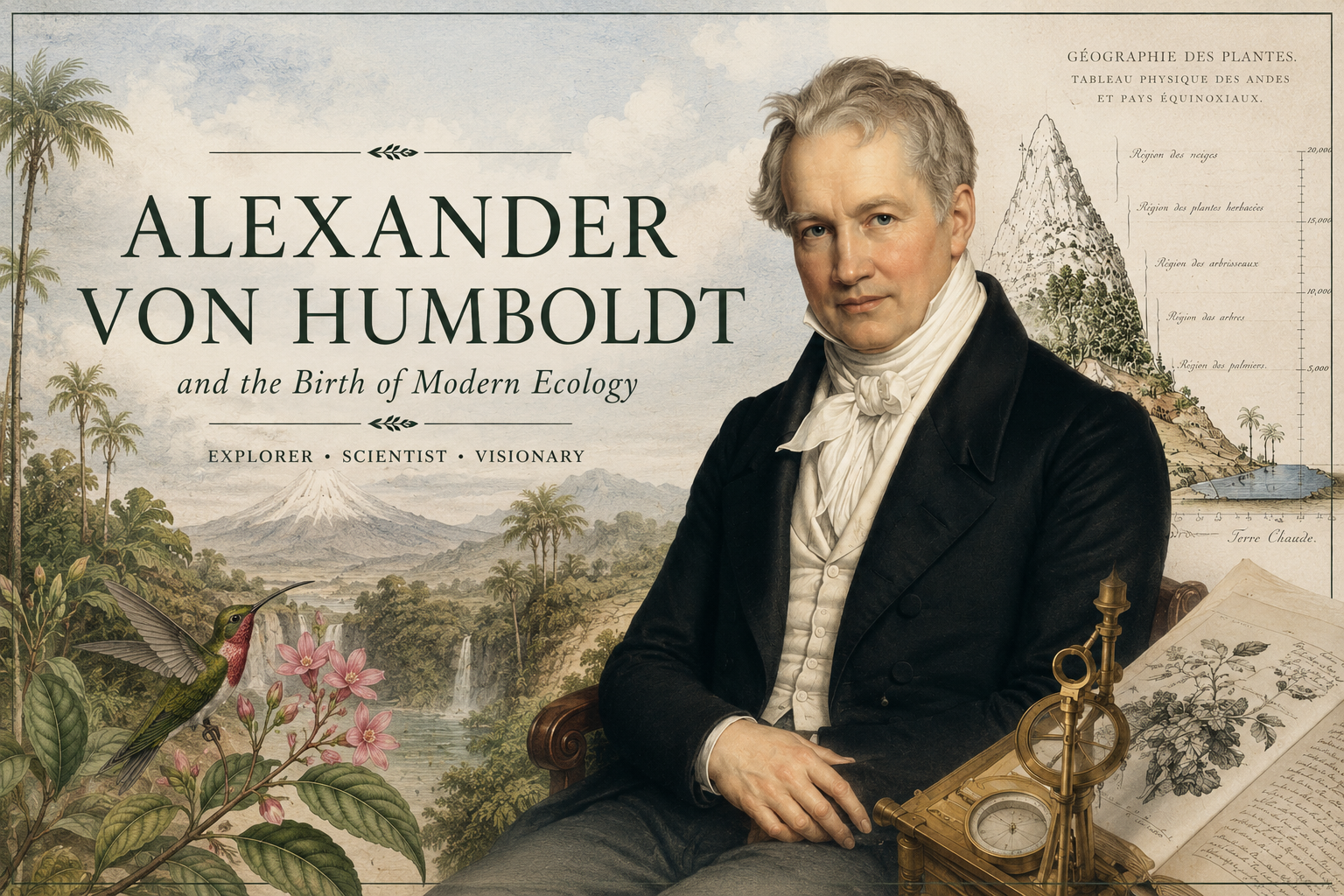
When people think of famous naturalists, Charles Darwin is often the first name that comes to mind. Yet decades before Darwin published On the Origin of Species, another scientist was transforming the way people understood the natural world. His name was Alexander von Humboldt, and many historians consider him one of the founders of modern ecology.
Humboldt was more than an explorer collecting exotic plants and animals. He was among the first scientists to recognize that nature functions as a complex web of relationships. Climate, geography, plants, animals, and even human activity were all connected in ways that few people had considered before. Today, this idea seems obvious, but at the beginning of the nineteenth century it was revolutionary.
His observations changed science forever and continue to influence how we understand ecosystems, biodiversity, and climate change today.
Who Was Alexander von Humboldt?

Alexander von Humboldt was born in Prussia in 1769. From an early age, he showed a strong interest in nature, geography, and exploration. After studying mining, geology, and natural sciences, he began pursuing a career that would eventually make him one of the most influential scientists of his era. Between 1799 and 1804, Humboldt undertook a remarkable expedition through South and Central America with the French botanist Aimé Bonpland. Together, they traveled through modern-day Venezuela, Colombia, Ecuador, Peru, Cuba, and Mexico, documenting landscapes, collecting plant specimens, and recording scientific observations.
Unlike many explorers of his time, Humboldt was not interested only in discovering new species. He wanted to understand how the natural world worked as a whole. He carefully measured temperature, altitude, rainfall, and other environmental factors while studying the plants and animals around him. In many ways, Humboldt’s expeditions helped define the great age of botanical exploration described in Plant Explorers: How Plants Traveled Around the World. His extensive records would later become the foundation for entirely new ways of studying nature.
Seeing Nature as a Connected System
Perhaps Humboldt’s most important contribution was his belief that nature should not be studied in isolated pieces. At the time, many scientists focused on describing individual plants, animals, or geological formations. Humboldt took a different approach. He believed that every element of the natural world was linked to countless others through complex relationships.

When he observed a forest, he did not simply record the species growing there. He considered how climate affected the vegetation, how altitude influenced temperature, how soil conditions shaped plant communities, and how human activity could alter the entire system. This holistic perspective was centuries ahead of its time. Today, it forms the basis of ecological science. Humboldt often described nature as a living network, where changes in one part could influence countless others. This concept remains central to modern ecology and environmental science.
Chimborazo and the Geography of Plants

One of Humboldt’s most famous scientific achievements emerged from his expedition to Chimborazo, a volcano in present-day Ecuador. As he climbed the mountain, he carefully recorded the plants growing at different elevations. He noticed that vegetation changed predictably as altitude increased. Tropical forests gave way to different plant communities, which were eventually replaced by alpine vegetation near the summit.
What made this observation remarkable was Humboldt’s realization that altitude could mimic the effects of latitude. The environmental conditions found high on a tropical mountain resembled those found much farther north or south on the globe. Using this insight, he created one of the first visual representations of plant distribution according to environmental conditions. His famous diagram of Chimborazo demonstrated how temperature, elevation, and vegetation were interconnected. This work laid the foundation for plant geography and biogeography, disciplines that remain essential to ecological research today.
How Humboldt Inspired Modern Ecology
Although the term “ecology” would not be coined until later by Ernst Haeckel, many of its core principles can be traced directly to Humboldt’s work. He showed that organisms do not exist independently from their surroundings. Instead, they are shaped by environmental conditions and interact continuously with other living and non-living components of their ecosystems.
Modern ecologists study relationships between species, climate, soil, water, and habitat. Humboldt was already exploring these connections more than two hundred years ago. His influence reached far beyond his own generation. Scientists across Europe and North America were inspired by his writings, observations, and methods.
Scientists Influenced by Humboldt
Among those influenced by Humboldt was Charles Darwin. Before embarking on the voyage of the Beagle, Darwin read Humboldt’s travel accounts and later credited them with inspiring his passion for exploration and natural history. Humboldt’s ideas also influenced Ernst Haeckel, who would eventually introduce the term “ecology” in the nineteenth century. Conservation pioneer John Muir admired Humboldt’s writings as well, particularly his appreciation for wilderness and the interconnectedness of nature.
Through these and many other scientists, Humboldt’s influence spread throughout biology, geography, conservation, and environmental science. Even today, researchers studying ecosystems continue to build upon principles that Humboldt helped establish.
One of the First Scientists to Warn About Human Impact
Humboldt was not only interested in how natural systems functioned. He was also among the first scientists to recognize that human actions could disrupt those systems. During his travels in South America, he observed the effects of deforestation and intensive land use. In particular, he noted changes around Lake Valencia in present-day Venezuela, where forests had been cleared for agriculture. Humboldt observed that removing trees affected soil stability, water availability, and local climate conditions. He argued that human activity could alter entire landscapes and trigger environmental consequences far beyond the immediate area.
These observations may seem familiar today, but they were remarkably unusual at a time when industrialization was only beginning to transform societies. Long before concepts such as climate change or ecosystem degradation entered public discussion, Humboldt was warning that humans were capable of reshaping the natural world in significant ways. His insights anticipated many of the environmental concerns that dominate scientific research today.
Why Humboldt’s Ideas Matter Today
The challenges facing the planet today highlight just how relevant Humboldt’s work remains. Climate change, habitat destruction, biodiversity loss, and ecosystem degradation are all examples of interconnected environmental problems. Understanding these issues requires exactly the kind of systems thinking that Humboldt championed.
Scientists now know that forests influence rainfall patterns, oceans regulate climate, pollinators support food production, and biodiversity contributes to ecosystem stability. These relationships are increasingly studied through the lens of interconnected systems rather than isolated components. This approach closely reflects Humboldt’s vision of nature.
His work reminds us that environmental challenges cannot be solved by examining individual species or habitats alone. Instead, they require an understanding of the relationships that connect entire ecosystems. More than two centuries after his travels, Humboldt’s central message remains as important as ever: everything in nature is connected.
A Legacy Beyond Science
Humboldt’s influence extended beyond scientific research. He was also a gifted writer who helped make science accessible to a broader audience. His books combined careful observation with vivid descriptions of landscapes, plants, and cultures, inspiring generations of readers to see nature with new eyes.
Artists, writers, explorers, and conservationists all drew inspiration from his work. His ability to combine scientific rigor with a deep appreciation for the beauty of the natural world made his ideas especially powerful. Today, his legacy can be seen not only in ecology and environmental science but also in the way people think about humanity’s relationship with nature.
Further Reading
For readers interested in learning more about Humboldt’s life, travels, and scientific influence, The Invention of Nature: Alexander von Humboldt’s New World by Andrea Wulf provides an engaging and well-researched introduction to his remarkable story. The book explores both his groundbreaking discoveries and the lasting impact he had on generations of scientists, including Darwin and many of the pioneers of modern environmental thought.
Conclusion
Alexander von Humboldt transformed the way people understood the natural world. Rather than viewing plants, animals, climate, and geography as separate subjects, he recognized them as parts of an interconnected system. This perspective became one of the foundations of modern ecology and continues to shape environmental science today.
From his observations on mountain slopes to his early warnings about human impacts on nature, Humboldt’s work demonstrated that understanding the world requires looking at relationships rather than isolated facts. More than two hundred years later, his vision of a connected planet remains one of the most important ideas in the history of science.