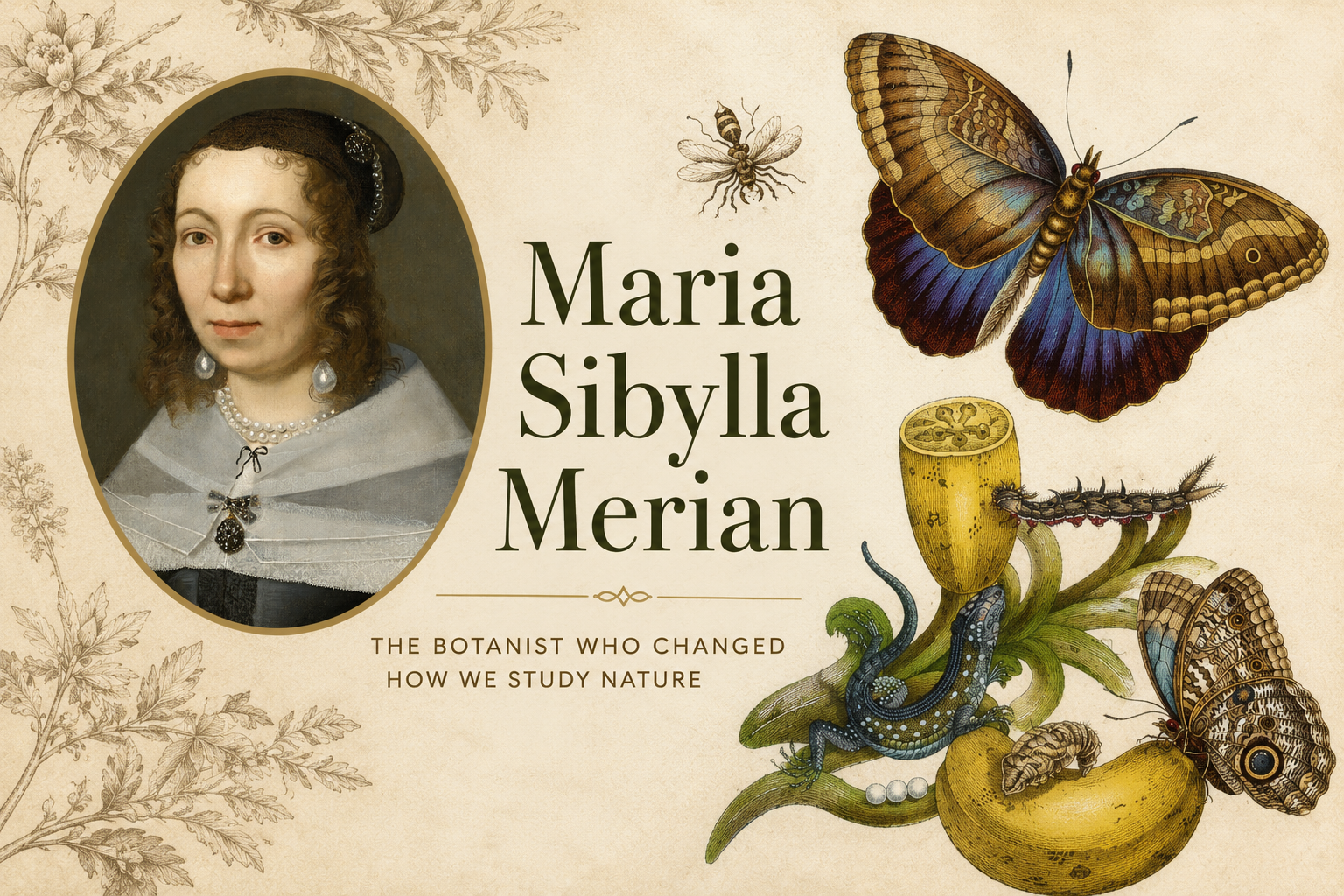

When people think of scientific pioneers, names like Charles Darwin or Carl Linnaeus often come to mind. Yet decades before many of the foundations of modern natural history were established, Maria Sibylla Merian was carefully observing plants, insects, and their relationships in ways that challenged conventional thinking.
Combining artistic skill with scientific curiosity, she documented the natural world with remarkable accuracy and became one of the first researchers to study organisms in their ecological context. Her work helped transform both botany and entomology, leaving a legacy that continues to influence science today.
For a quick introduction to her fascinating life and achievements, you can also watch my video about Maria Sibylla Merian.
Who Was Maria Sibylla Merian?
Maria Sibylla Merian was born in Frankfurt, Germany, in 1647 into a family of artists and publishers. Her stepfather, Jacob Marrel, was a respected flower painter who introduced her to artistic techniques at an early age.
Unlike many girls of her time, Merian developed a strong interest in the natural world. As a child, she collected caterpillars and observed their development, recording her findings through detailed drawings and notes. These early observations would shape the course of her life and career.
At a time when women had little access to formal scientific education, Merian pursued knowledge independently. Through careful observation and documentation, she built expertise that would eventually earn her recognition across Europe.
Why Maria Sibylla Merian Was Revolutionary
She Observed Nature Instead of Repeating Old Beliefs
During the seventeenth century, many people believed that insects appeared spontaneously from mud, decaying matter, or other non-living materials. These ideas had persisted for centuries and were rarely questioned.
Merian approached the subject differently. Rather than relying on accepted beliefs, she raised caterpillars herself and carefully documented each stage of their development. Her observations clearly demonstrated that butterflies and moths emerged through a process of metamorphosis.
By studying living organisms directly, she helped replace myths with evidence-based understanding.
She Connected Plants and Insects
One of Merian’s most important contributions was her ability to see connections within nature.
Rather than illustrating insects in isolation, she frequently depicted them alongside the plants they depended on. Her work documented feeding relationships, host plants, and life cycles, revealing interactions that many naturalists had overlooked.
Today, understanding ecological relationships is a fundamental part of biology. In Merian’s time, however, this approach was highly unusual and represented a significant shift in scientific thinking.
The Suriname Expedition
A Journey Few Women Would Have Attempted
In 1699, at the age of fifty-two, Maria Sibylla Merian embarked on an ambitious expedition to Suriname, a Dutch colony in South America. Such a journey was challenging even for male naturalists. Tropical diseases, difficult travel conditions, and limited infrastructure made scientific exploration risky. For a woman to undertake such a voyage independently was almost unprecedented. Determined to study tropical species firsthand, Merian largely financed the expedition herself and traveled with her daughter Dorothea Maria.
Documenting Tropical Plants and Insects

During her time in Suriname, Merian observed and illustrated a wide range of plants, insects, reptiles, and other animals. Rather than relying on specimens collected by others, she conducted field observations and documented organisms within their natural environments. This allowed her to record ecological interactions with an accuracy rarely seen in scientific publications of the period.
Her illustrations combined scientific detail with artistic beauty, helping readers understand not only what species looked like but also how they interacted within their ecosystems.
Her Most Important Scientific Work
In 1705, Merian published Metamorphosis Insectorum Surinamensium, one of the most influential natural history books of its time.
The work presented detailed illustrations of tropical insects alongside the plants they relied upon throughout their life cycles. Each plate combined artistic excellence with scientific observation, making the book both visually stunning and scientifically valuable.

Unlike many natural history works of the era, Merian’s publication was based largely on direct observation rather than secondhand reports. This commitment to firsthand research helped establish new standards for scientific documentation.
Maria Sibylla Merian’s Contribution to Botany
Although Merian is often celebrated for her work with insects, her contributions to botany were equally significant.
Her illustrations treated plants as more than decorative subjects. She carefully documented plant structures and showed how they interacted with insects and other organisms.
By recording host plants and ecological relationships, she provided valuable information about species interactions that would later become central to ecological science.
Merian’s work also influenced the development of botanical illustration. Her ability to combine scientific accuracy with visual clarity helped establish standards that continue to guide botanical artists today.
Through her observations, she demonstrated that understanding nature requires studying relationships between organisms rather than viewing species in isolation.
Challenges as a Woman in Science
Maria Sibylla Merian pursued scientific research in a society where opportunities for women were severely limited. Universities and scientific institutions were largely inaccessible to women, and formal recognition often went to male scholars. Despite these barriers, Merian built a successful career through her own determination, talent, and dedication to observation.
Her publications gained international attention, and collectors, scientists, and naturalists across Europe admired her work. While she did not receive the same institutional support available to many male researchers, her achievements ultimately secured her place among the most important naturalists of her era.
Why Maria Sibylla Merian Still Matters Today
Maria Sibylla Merian’s influence extends far beyond the seventeenth century. Her emphasis on direct observation reflects principles that remain central to modern scientific research. Her documentation of ecological relationships anticipated ideas that would later become fundamental to ecology and conservation biology.
She also helped establish scientific illustration as a powerful tool for communicating knowledge about the natural world. Today, Merian is recognized not only as an artist and entomologist but also as an important figure in the history of botany and environmental science.
She is also one of many remarkable women whose contributions shaped our understanding of plants and nature. If you’d like to discover more pioneering female scientists, explore Women in Botany.
Frequently Asked Questions About Maria Sibylla Merian
Was Maria Sibylla Merian a botanist?
Maria Sibylla Merian is often described as a naturalist, entomologist, and scientific illustrator. However, her detailed study of plants and plant-insect relationships also makes her an important figure in the history of botany.
Why is Maria Sibylla Merian famous?
She is famous for her groundbreaking observations of insect metamorphosis, her scientific illustrations, and her expedition to Suriname, where she documented tropical plants and animals.
What did Maria Sibylla Merian discover?
Merian helped demonstrate the complete life cycles of insects through direct observation and documented important ecological relationships between insects and plants.
Why was her trip to Suriname important?
The expedition allowed her to study tropical species in their natural habitats and resulted in some of the most influential scientific illustrations of the early modern period.
What is Metamorphosis Insectorum Surinamensium?
It is Merian’s landmark publication from 1705, featuring detailed illustrations and observations of tropical insects and the plants associated with them.
Further Reading
Readers interested in learning more about Merian’s life, artwork, scientific methods, and lasting influence on natural history may enjoy Maria Sibylla Merian: Illuminating the World of Natural History.
Final Thoughts
Maria Sibylla Merian transformed the study of nature through a combination of curiosity, artistic talent, and scientific rigor.
At a time when many accepted traditional explanations without question, she chose to observe the natural world directly. Her research improved understanding of insect life cycles, highlighted the importance of ecological relationships, and contributed to the development of modern botany.
More than three centuries later, her work remains a powerful reminder that careful observation can change how we understand the world around us.