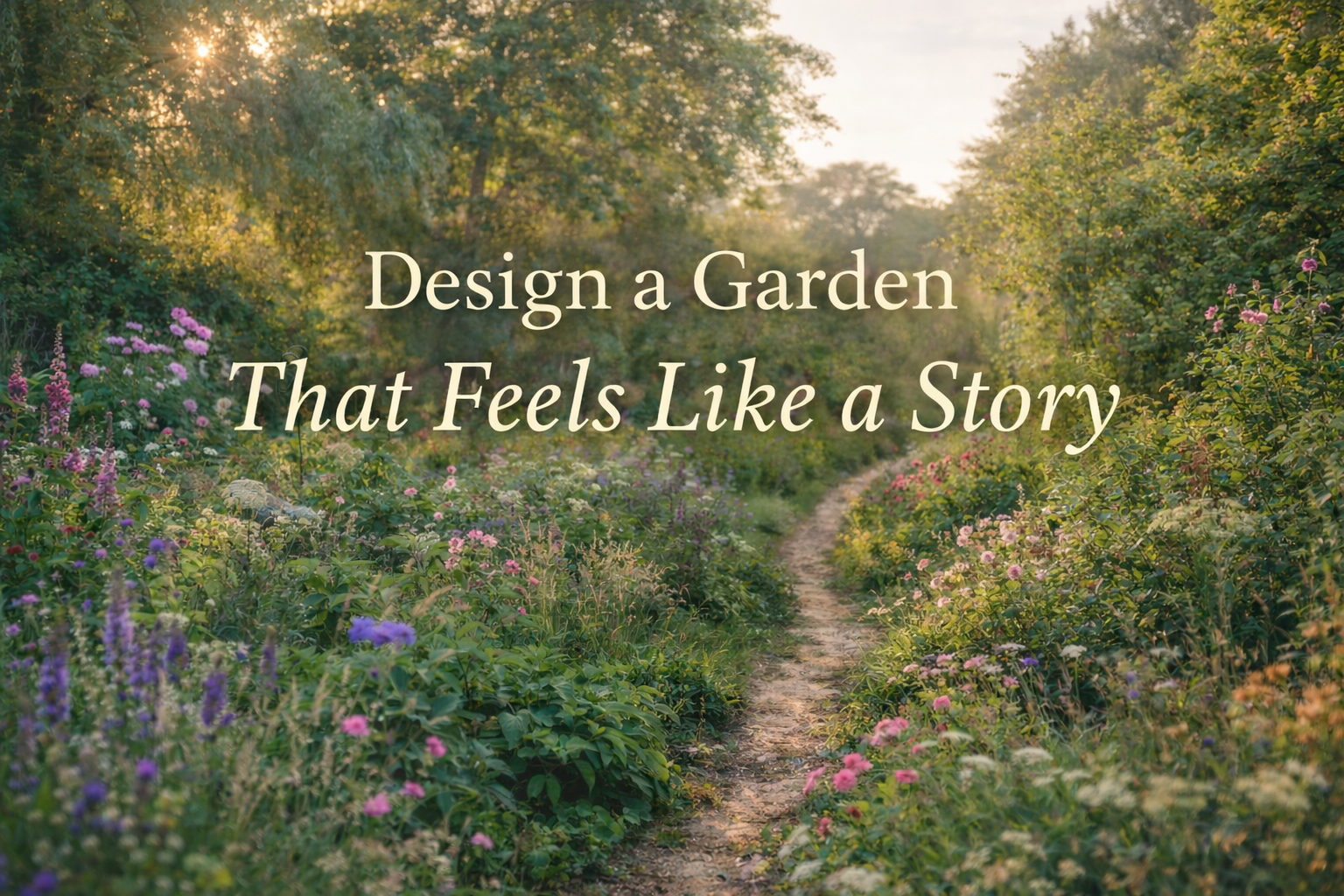
Some gardens are beautiful. Others feel like stepping into a story.
They invite you in without explaining why. You follow a path, slow down without noticing, and suddenly you’re not just looking at a garden – you’re inside it. Designing a garden like this isn’t about perfect layouts or strict rules. It’s about creating a space that unfolds gradually, where atmosphere and composition guide your experience more than structure ever could.
What Makes a Garden Feel Like a Story?
A storytelling garden doesn’t reveal itself all at once. Instead of being clearly structured and easy to understand, it draws you in piece by piece. You discover it as you move through it – not from a single fixed viewpoint.
What makes the difference is not the choice of plants alone, but how everything works together: the way spaces connect, how your eye is guided, and how the garden feels in different moments of the day. It’s less about design in the traditional sense and more about creating an experience.
Start With a Mood, Not a Layout
Before thinking about paths or planting schemes, it helps to pause for a moment and ask a different question:
What should this garden feel like? Not in a technical way, but intuitively.
You might imagine a space that feels calm and soft, or something wilder and more alive. Maybe you’re drawn to a slightly overgrown, romantic atmosphere or to something darker and more dramatic. This feeling becomes your foundation. It quietly shapes every decision that follows, even if you don’t consciously think about it again.
If you already have a specific aesthetic in mind – for example a darker, more atmospheric space – you might find inspiration in my guide to Gothic plant choices.
Create Flow – The Path as Your Narrative Line

In a garden like this, movement matters. A straight path shows everything immediately. There’s nothing left to discover. But a gently curving path changes the experience entirely. It slows you down. It creates anticipation.
You don’t have to overthink this. Even small shifts in direction, a slight narrowing, or plants leaning into the path can make a space feel more alive and less controlled. The goal isn’t to guide someone efficiently from one point to another. It’s to make them want to keep going.
Layer Your Garden Like a Scene
Depth is what makes a garden feel immersive. Instead of placing plants next to each other in a clear and separated way, try to think in layers as if you’re building a scene rather than arranging a bed.
Low plants blend into taller ones. Shapes overlap. Some areas feel dense, others more open. Nothing needs to be perfectly visible. This kind of composition creates a sense of richness. It makes the garden feel larger, more complex, and more natural – even in a small space.

Use Plants as Characters, Not Decoration
When you start to see plants differently, your whole approach changes. Instead of filling space, each plant begins to play a role. Some quietly structure the garden. Others draw attention. And some simply connect everything together without standing out.
You don’t need many different species to create interest. Often, repetition and intention are far more powerful than variety. It’s not about how many plants you use but how they relate to each other.
Create Moments of Mystery
A garden becomes more engaging when it doesn’t explain itself completely. Small elements of uncertainty – a partially hidden path, a corner you can’t fully see, plants that obscure what lies behind them . create a quiet sense of curiosity.
You find yourself wanting to look closer. To take another step. And that’s exactly what makes the space feel alive.
Light, Texture & Seasons – The Atmosphere Layer
This is where everything comes together. Light changes how a garden feels throughout the day. Morning light can feel soft and gentle, while evening light adds warmth and depth. Shadows move, highlighting different parts of the space over time.
Texture plays a similar role. Fine, airy plants respond to the wind and create movement, while stronger structures add contrast and stability. And then there are the seasons. A storytelling garden doesn’t rely on a single moment of perfection. It evolves. It shifts. It offers something different depending on when you enter it.
Even subtle details – like natural materials or carefully chosen decorative elements – can support this atmosphere. If you’re looking for inspiration for pieces that blend into a natural setting rather than standing out, you can explore options at Bloomling. The key is always the same: everything should feel like it belongs.
Let Go of Perfection
One of the hardest parts is letting go. A storytelling garden isn’t neat in the traditional sense. It doesn’t follow strict lines or stay exactly as planned. Plants grow differently than expected. Some spread, others fade. Edges soften over time.
And instead of correcting every small imperfection, it often helps to allow it. Because that’s what makes the space feel real.
A Gentle Way to Begin
If you want to start, you don’t need a detailed plan. It’s enough to begin with a feeling, choose a few plants that reflect it, and create a simple path through your space. From there, you can slowly build around it – adding layers, adjusting, observing.
A garden like this isn’t designed in one step. It grows into itself.
Conclusion
A garden doesn’t need to impress. It doesn’t need to be perfect or complete. But if it makes you pause for a moment if it draws you in, even quietly – then it has already become something more than a garden. It has become a story.