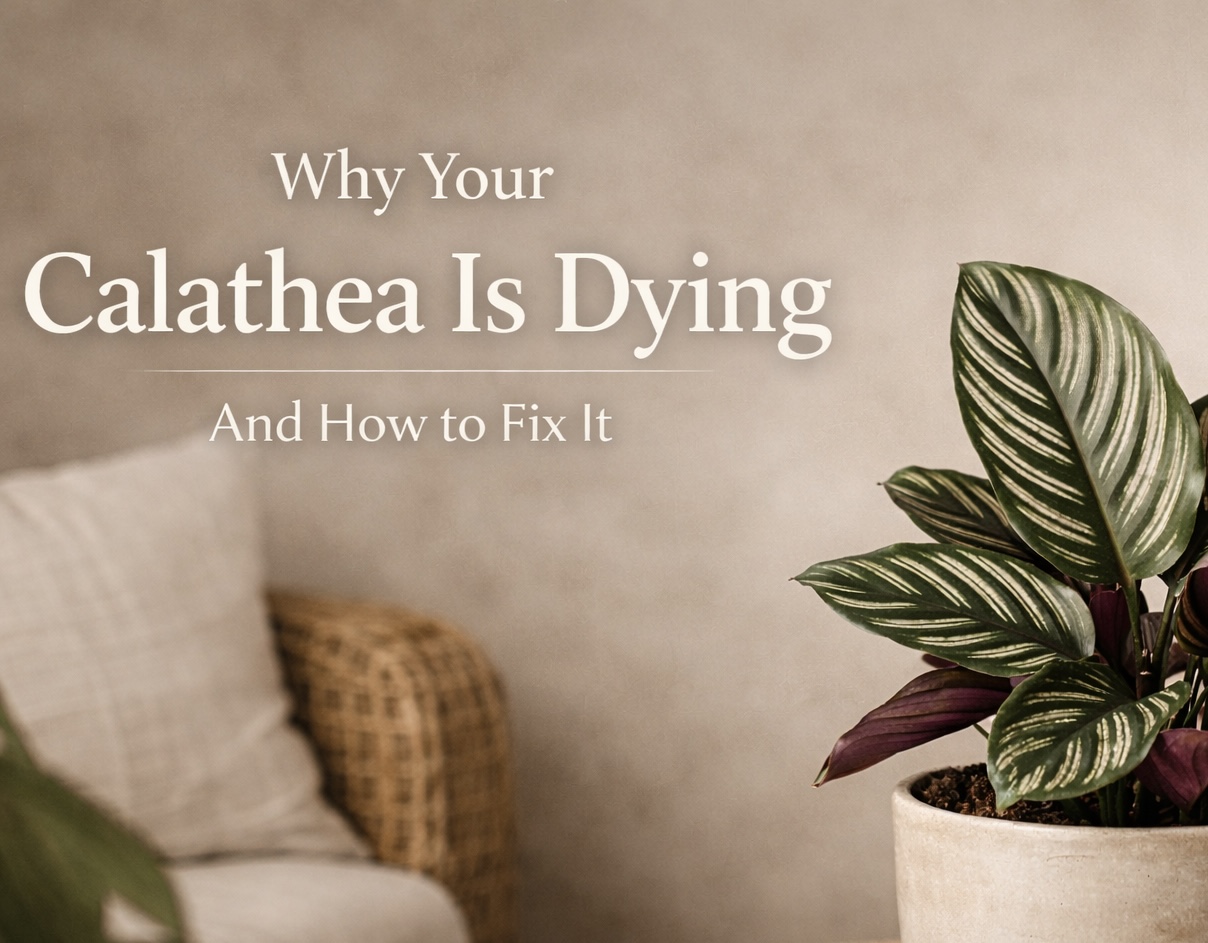
Calatheas are known for their striking, almost painted leaves and for being frustratingly difficult to care for.
You water them, place them carefully, try to follow every tip… and still, something goes wrong. Leaves curl, edges turn brown, and the plant that looked perfect just weeks ago suddenly starts declining.
If that sounds familiar, you’re not alone. And more importantly, you’re probably not doing everything wrong.
Calatheas simply have very specific needs. Once you understand what they actually respond to, caring for them becomes much more predictable.
Why Calatheas Are So Difficult
Calatheas come from tropical environments where conditions are stable: warm temperatures, high humidity, and soft, filtered light.
Your home is very different. Light changes throughout the day, the air is often too dry, and small inconsistencies in care show up quickly.
That’s why Calatheas feel so sensitive. They don’t slowly decline – they react fast and visibly. What looks like “drama” is really just a plant responding honestly to its environment.
Light – The #1 Misunderstood Factor
“Bright indirect light” is the most common advice for Calatheas and also one of the most misleading.
What looks bright to us isn’t necessarily enough for a plant. Our eyes adjust to light, but plants depend on actual light intensity.
Most indoor spaces only reach around 500–1,500 lux, which is too low for healthy growth. Calatheas do much better in a range of roughly 2,000–5,000 lux – bright, but without direct sun that could damage their leaves.
This is where many people go wrong. “No direct sunlight” often turns into placing the plant in a dim corner, where it can survive for a while but won’t thrive.
If you want to be sure, measuring light can help. A simple lux meter often shows that a plant just needs to be placed closer to a window or in a brighter spot.
A good placement is usually near a window with filtered light, where the plant gets consistent brightness without harsh sun exposure.
Watering Your Calathea the Right Way
Watering is where many Calatheas start to struggle – not because people forget to water them, but because it’s easy to get the balance wrong.
Calatheas don’t like to dry out completely, but they also don’t tolerate constantly wet soil. What they need is a steady level of moisture. The soil should feel slightly damp, not soggy and not dry.
A common mistake is watering on a fixed schedule instead of responding to the plant. Depending on light, temperature, and season, a Calathea’s needs can change quite a bit. Checking the soil regularly is much more reliable than sticking to exact intervals.
Water quality also plays a bigger role than many expect. Calatheas are sensitive to minerals and chemicals often found in tap water, which can lead to brown edges over time. If you notice this happening despite otherwise good care, switching to filtered or rested water can make a noticeable difference.
Humidity – The Real Secret
If there’s one factor that makes the biggest difference for Calatheas, it’s humidity.
In their natural environment, humidity levels are consistently high. In most homes, especially during colder months, the air is much drier than what these plants are used to. This is often the hidden reason behind curling leaves and dry, brown edges.
Increasing humidity doesn’t have to be complicated, but it does need to be consistent. Placing plants closer together can help a little, and certain rooms like bathrooms or kitchens naturally offer better conditions. However, in many cases, these small adjustments aren’t quite enough.
A humidifier is usually the most effective solution if you want to create a stable environment. It allows you to keep humidity in a range where Calatheas can actually thrive, instead of constantly reacting to dry air.
Common Problems (And What They Mean)

Calatheas are very good at showing when something isn’t right – you just need to know how to read the signs.
Curling leaves are often a response to dryness, either from low humidity or not enough water. Brown edges usually point to dry air or issues with water quality. Yellow leaves, on the other hand, are more commonly linked to overwatering and roots staying too wet for too long.
If a plant starts drooping, it’s often reacting to sudden changes, such as a new location or shifting conditions. In many cases, this isn’t permanent damage but a sign that the plant needs time to adjust.
Understanding these signals makes it much easier to react early, instead of guessing what might be wrong.
How to Save a Dying Calathea
If your Calathea is already struggling, the most important thing is not to overcorrect everything at once.
Start by checking its environment. Is it getting enough light? Is the air too dry? Is the soil staying wet for too long or drying out too quickly? Small adjustments in the right place often make a bigger difference than drastic changes.
Improving humidity and adjusting your watering routine are usually the most effective first steps. If the soil feels compacted or stays wet for too long, repotting into a more suitable mix can also help the roots recover.
With the right conditions, Calatheas can bounce back surprisingly well — but they need consistency more than anything else.
The Truth About Calatheas
Calatheas are often described as beginner-friendly plants, but that’s not entirely accurate.
They aren’t impossible to care for, but they do require an environment that matches their natural conditions more closely than many other houseplants. In some homes, that’s easy to achieve. In others, it can be a constant challenge.
If you’ve struggled with them, it doesn’t mean you’re bad with plants. It often just means the conditions aren’t a perfect fit and that’s completely okay.
Looking for Easier Alternatives?
If you love the look of Calatheas but find them difficult to care for, there are plenty of other plants that offer similar visual interest without being quite as demanding.
Some varieties have equally striking colors or patterns but are much more forgiving when it comes to humidity and watering.
Want to Go Deeper?
If you want to understand Calathea care on a deeper level, it can be helpful to look into more detailed resources that go beyond the basics.